
Emergency Air Duct Cleaning Near Me: What New Dorp Homeowners Should Do First
Your first move in an air duct emergency is not to call anyone – it’s to turn the HVAC system off. Every emergency we get called about in New Dorp starts the same way: something burning, something leaking, or something smelling wrong, and the instinct is to run the system to “clear the air.” That instinct is backwards. A running system is a distribution network, and whatever is in your ducts right now is being delivered to every bedroom in the house. Shut it down, leave the thermostat alone, and read the next section before you touch anything else.
If you’d rather not sort through this yourself, call (877) 759-0546. We answer 24/7. Fast dispatch from 7am to 7pm, Sunday through Friday.
Why Step One Is Always “Turn the System Off”
Contaminants inside ductwork are mostly settled. They sit in the low spots, along seams, and in the return plenum, and they stay there as long as air is moving slowly through the house the way it normally does. A blower running at full speed changes that. It lifts settled particles into the airstream, pushes them through the supply trunk, and deposits them into living spaces that were clean an hour earlier.
The same logic applies to odor. Smoke residue, sewage vapor, or the musty smell that signals microbial growth travels the system rather than staying where it started. Running the fan during that window spreads the source instead of diluting it.
What to do instead:
- Set the thermostat to OFF, not to fan-only or “circulate.” Those settings still run the blower.
- Close supply registers in rooms nearest the source if you can reach them safely.
- Open windows on the opposite side of the house from the affected area for cross-ventilation.
- Do not run any portable fans aimed at the ductwork or the source zone – that just aerosolizes more.
Once the system is off, the situation stops getting worse. That’s the whole point of the first step: buying time without adding contamination to it.
Step-by-Step First Response by Emergency Type
Different emergencies call for different containment moves, but the HVAC system stays off in all four cases below. Here’s how to handle each one while you wait for a technician.
Fire and smoke damage
Smoke residue is oily and it sticks to duct walls rather than blowing through. Leave the system off even after the fire is out. Don’t wipe surfaces inside the ductwork or spray household deodorizers into registers – those can set residue into the metal and complicate the cleaning. Change nothing until the system has been assessed.
Sewage backup vapor
This is the one that catches homeowners off guard. When a basement backup releases sewage gases, those gases enter through floor drains and can migrate into return-air paths. Turn the thermostat off, keep people and pets out of the affected rooms, and ventilate from an unaffected side of the house. Don’t run the HVAC to “dry it out.” As we describe below, the results of doing that are not subtle.
Sudden mold odor
If a musty smell arrives quickly and doesn’t fade after a day or two of ventilation, the likely source is moisture somewhere in the system – often a wet cooling coil, a clogged condensate line, or a damp section of duct in a humid space. Turning the system off until it’s inspected prevents spores from being carried into every room while the moisture problem is still active. Call for air duct cleaning before the smell turns into visible growth.
Flood and water intrusion
Water in insulation-lined ducts or a wet air handler is an active growth site. Keep the system off and photograph everything before moving anything. If water reached the ductwork itself, don’t run the system again until it’s been inspected. Restarting a wet system moves moisture into the coil and can cause a bigger mold problem than the flood did.
Is It a Duct Problem or an HVAC Problem?
Not every air emergency is a duct emergency, and calling the wrong specialist first costs you a wasted visit. Before you dial, check three things: where the smell is strongest, whether the smell is present when the system is off, and whether there’s visible debris, water, or soot at a register.
- Smell strongest at one register: usually a localized issue near that register – debris, moisture, or a dead animal in the branch duct.
- Smell throughout the house but worse when the system is running: contamination in the main ductwork or return plenum. This is a duct call.
- Smell only when the system starts, gone minutes later: often the cooling coil or the drain pan – an HVAC service issue before it’s a duct issue.
- Smell present even with the system off: the source is probably outside the system itself. A wet spot, a source in the crawlspace, or an appliance venting issue.
In our experience, the fastest way to sort this is to describe the smell and the timing over the phone. A technician can tell you whether the right visit is HVAC cleaning or duct work – and if it’s both, they’ll arrive set up for both.
What to Tell the Dispatcher Before Anyone Arrives
What you say on the phone determines which equipment gets loaded and what the technician walks in knowing. A clean description prevents a second visit. Give them the following in your first call:
- The source. Be specific: fire, sewage backup, water intrusion, mold odor, or unknown. “Weird smell” gets you a general visit; “basement sewage backup three days ago, smell now through the vents” gets you the right one.
- Whether the system has been running. If it has, mention how long. That changes how far contaminants may have spread.
- Any water or moisture contact. Flooded ducts, a wet coil, or a wet air handler.
- House facts. Number of floors, whether the ductwork is accessible, whether the ducts are flex or rigid, and whether anyone in the home has a respiratory condition.
For a contamination emergency, the right setup is a HEPA negative air machine with containment at the source. We use Nikro HEPA vacuum technology for negative-pressure containment and Abatement Technologies air filtration units on site to capture particulates as they’re released, so the cleaning process doesn’t recirculate contaminants into the house. Antimicrobial treatment may be part of the job if growth is present. Mentioning these to whoever answers is a fair question – a company that can’t tell you what equipment they plan to bring likely doesn’t have it.
A quick note on what makes this easier: the air inside your home is only as clean as the system moving it. If the source was water damage or smoke, that’s a whole-system problem, not a duct-only problem, and the equipment list should reflect that.
How We Handle It
We’re often asked whether running the HVAC after a sewage backup is actually that bad, or if it just smells bad. Here’s the honest version: a basement backup releases aerosolized bacteria, and running the blower distributes those particles through every supply register in the house before a technician gets there to assess. It’s a genuine mistake, and a common one – people panic about the smell and try to solve it with the system itself. (We’ve talked more than one homeowner out of a second, larger problem on the same visit.)
The right move is to leave the thermostat alone and let it be assessed. Here’s how we work an emergency call:
- The system stays off until a technician confirms it’s safe to run, or confirms it needs to be fully cleaned before restart.
- The technician does a pre-cleaning assessment: photographs the source, checks the return and supply trunks, and identifies the spread pattern before cleaning begins.
- Containment goes in first. A HEPA negative air machine with source-capture at the register is set up before any rotobrush work begins.
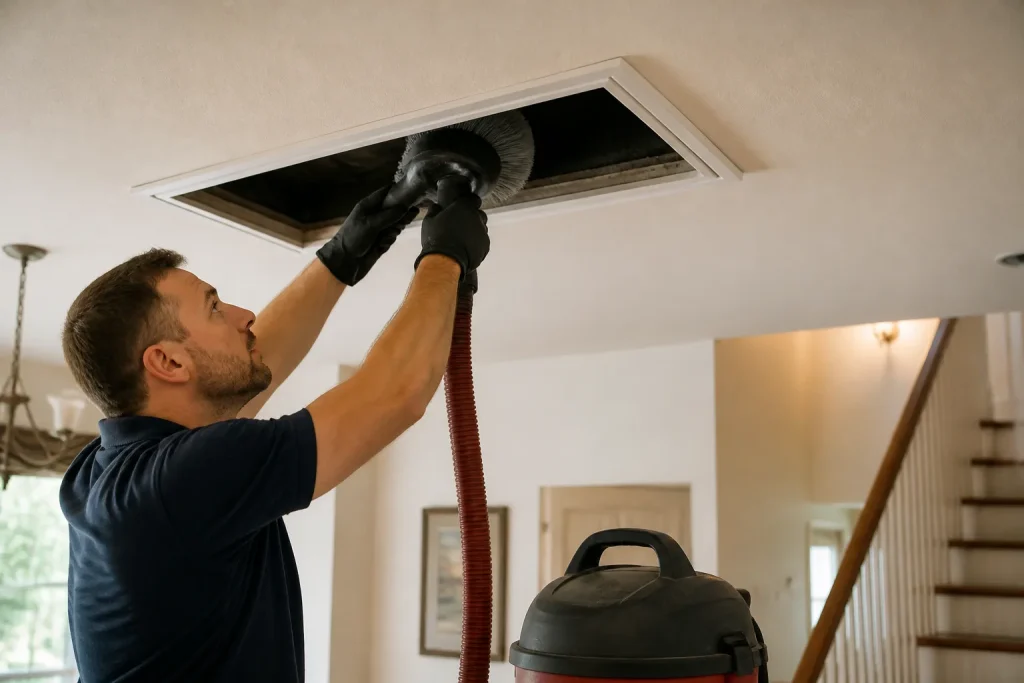
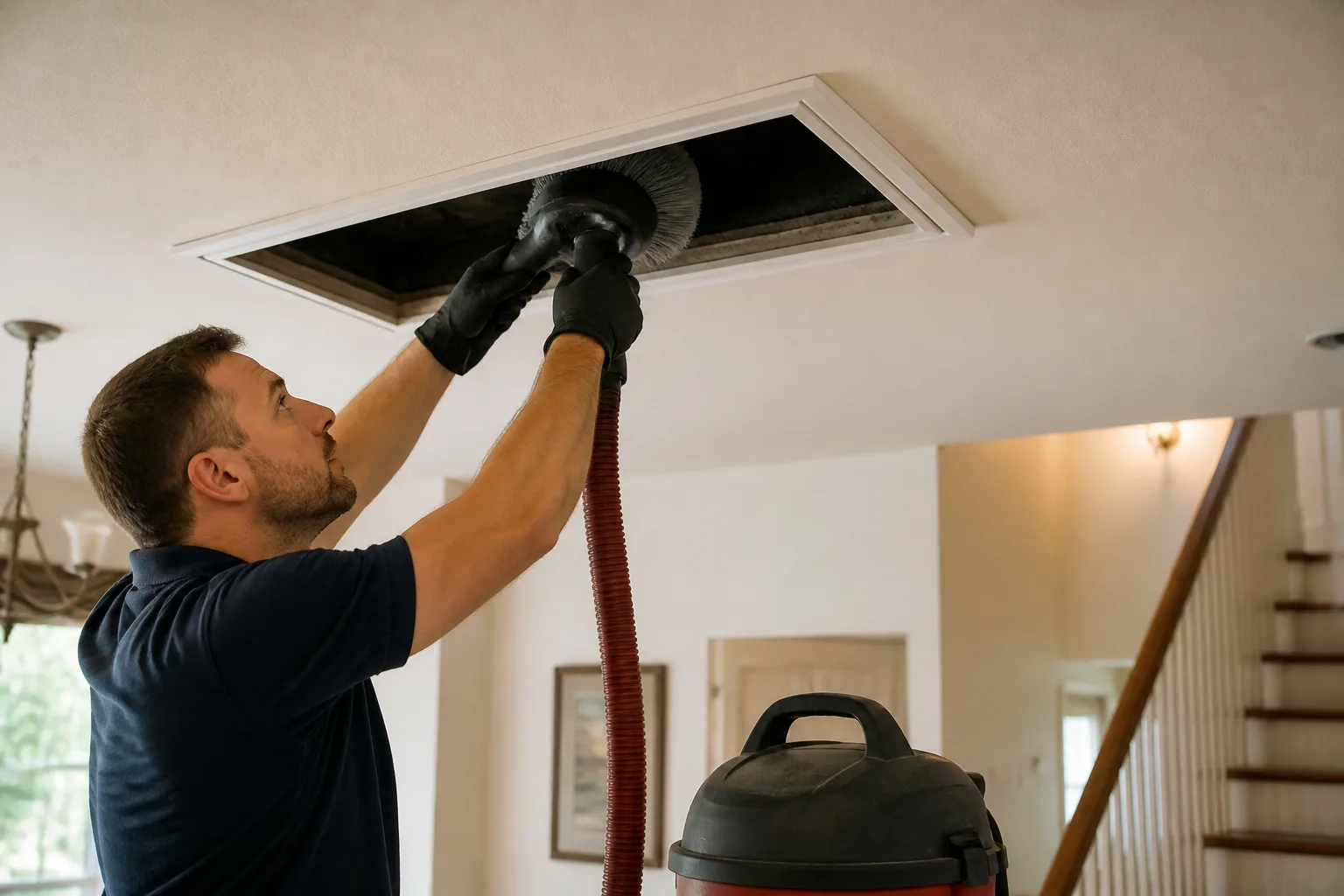
- Rotobrush rotary-contact cleaning dislodges source debris from duct walls, and the vacuum captures it as it releases.
- If the source was water damage or a leaky seam, we repair and seal it rather than cleaning around it – the leak will cause the same problem again if it isn’t closed.
We don’t just clean – we seal, repair, and sanitize. That sequence is why you’re not chasing the same problem six months later.
Documentation for Insurance Claims
Insurance adjusters work from evidence, and the evidence you collect in the first hour matters more than anything you say on a claim form. Before anyone moves a thing:
- Photograph the source itself – the sewage backup, the water line, the smoke-damaged register, the mold spot.
- Photograph the registers in each affected room, close enough that the debris or stains are visible.
- Photograph the thermostat setting, to demonstrate the system was not running when you found the problem.
- Do not clean up before taking pictures. Do not throw away any filter, insulation, or duct material until it’s photographed.
Ask for written technician notes that describe what was found and what was done – not a one-line invoice. A written description of the assessment, the cleaning sequence, and the equipment used is the document an adjuster reads. We photograph every pre-cleaning condition and provide written notes on every job.
When to Call a Pro (Versus Waiting)
If the smell is source-specific in one room and the system has never been running since the incident, you have some time to think. Call a tech now if any of these are true:
- The HVAC system ran after the source event – the contaminants were distributed.
- You or anyone in the home has asthma or a respiratory condition.
- The source was sewage, fire, or water intrusion into the ductwork itself.
- The smell has spread to rooms far from the source.
Related services in New Dorp: Beyond emergency cleaning, part of a full-system overhaul is the service most people forget until it’s a problem. That’s dryer vent cleaning – lint builds up over years and is the leading cause of dryer fires. It’s also worth asking about our full air pathway coverage under Air Duct Cleaning New Dorp – the assessment that maps ducts, vents, and the unit in one pass.
Red Flags in Emergency Duct Cleaning Responses
An emergency makes people price-blind. That’s what bad operators count on. If the first question a company asks is “how much did they quote you” instead of “what happened,” that’s a tell. Here’s what to watch for:
- A price quoted before an inspection. Every legitimate job needs a written estimate after assessment. If they’ll quote you over the phone, expect a different number when they arrive.
- No containment plan. If they don’t mention a negative-air machine or source capture, they’re going to blow contaminants around your house while they work.
- “Cleaning” with no repair conversation. Leaks and gaps in the ductwork are the root cause, not the symptom. Cleaning around them doesn’t solve anything.
- Unwillingness to put the estimate in writing. The written estimate sets the final price. Nothing else should.
- Antimicrobial treatment by default. Antimicrobial is appropriate when growth is present, not as an upsell added to every job.
Estimates should be free and per-job, not per-vent. If a company quotes a flat per-duct price over the phone, that’s not an estimate, that’s a hook.
The Bottom Line
In any air duct emergency in New Dorp, the sequence is the same: turn the HVAC off, ventilate from an unaffected side, photograph everything, describe the source accurately when you call, and don’t let anyone quote a price before they’ve seen it. Skipping a step in that sequence can spread contamination further, and the wrong equipment arriving on a call means a second visit and a bigger mess.
The right call brings a technician who shows up with a HEPA negative air machine, a pre-cleaning assessment, and a written estimate after the walk-through. We work with professional-grade Rotobrush and Nikro systems and Abatement Technologies filtration on every job, and we clean the whole air pathway – not just the ducts.
If you’re in New Dorp and need help, Air Duct Cleaning New Dorp offers free estimates. Call (877) 759-0546. We answer 24/7. Fast dispatch from 7am to 7pm, Sunday through Friday.
Frequently Asked Questions
Most emergency duct cleanings in New Dorp run on a per-job written estimate after inspection, not a per-vent price, because the scope varies with the type of contamination and how far it spread. A source-specific issue (one register, one branch) is generally a smaller job than a whole-house distribution. The written estimate sets the final price. Call (877) 759-0546 for an exact quote – estimates are free.
No. Running the system after smoke or sewage or water intrusion spreads the contamination through every supply register in the house. Turn the thermostat to OFF, open windows on an unaffected side, and leave the system off until a technician assesses it.
You should get pre-cleaning and post-cleaning photographs of your own ductwork and written technician notes describing what was found and what was done. Any company that won’t document the job in writing before and after is a red flag. Call (877) 759-0546 – estimates are free.
In a typical New Dorp home with no source event, duct cleaning is a periodic maintenance item – most homes don’t need it yearly. What changes the calculus is any of the four emergency sources (fire, sewage, water, sudden mold), a recent renovation that distributed dust, or a new HVAC install. If any of these apply, an assessment is worth more than waiting.
Written by the team at Air Duct Cleaning New Dorp.
Need Air Duct Cleaning Help?
Call Air Duct Cleaning New Dorp - the local pro we connect you with is licensed and insured, here with fast help in New Dorp.
(877) 759-0546