
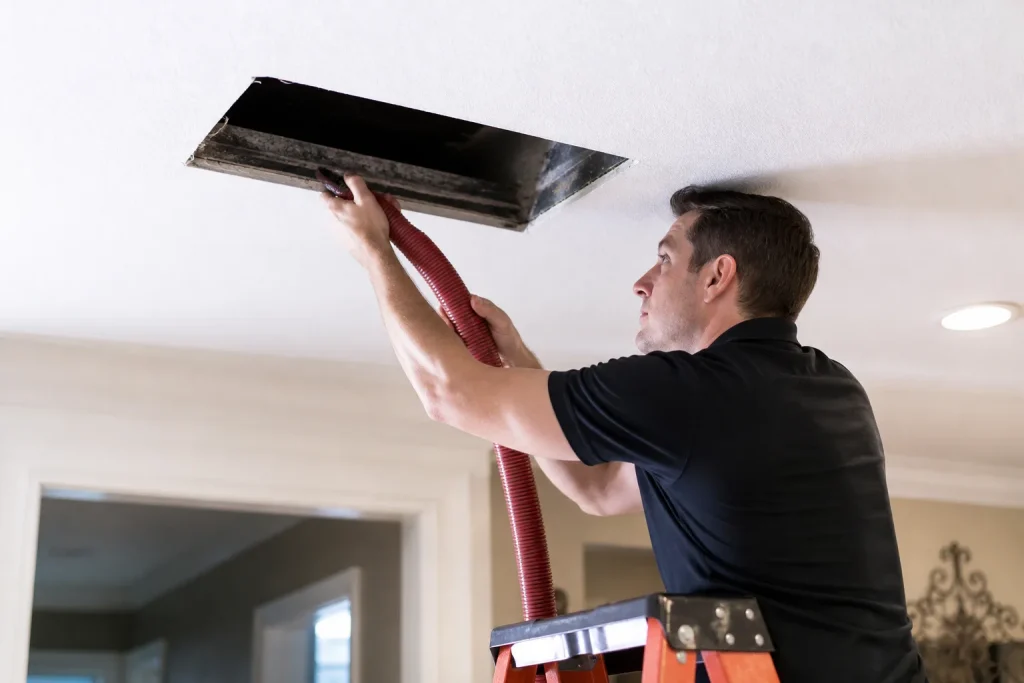

Air Duct Cleaning: Repair or Replace? How New Dorp Homeowners Decide
A duct system leaking 30% of its air at the joints will perform almost exactly the same after a thorough cleaning as it did before. The debris was never the real problem. The pressure loss was. That’s the expensive mistake we see most often in residential HVAC maintenance: paying for cleaning when the actual fix was sealing, or replacing a whole system when three joints needed mastic and a mesh patch. Here’s how New Dorp homeowners can tell which category they’re actually in.
Short answer up front: cleaning is right for contaminated but structurally sound ducts. Cleaning plus repair and sealing is right for leaking joints, separated fittings, and crushed runs. Replacement is only right when the duct material itself has failed. If you’d rather have a pro sort it out than crawl through the attic yourself, call (877) 759-0546.
Why Cleaning Without Sealing Wastes Most of the Money
Clean ducts that still leak are clean ducts that still leak. That sounds obvious, and yet it’s the single most common gap in how air duct cleaning gets sold. A technician runs a rotary brush through, pulls a mountain of debris out of the return, and the homeowner sees the before-and-after photos and feels good about it. Six weeks later the dust is back and the upstairs bedrooms are still two degrees warmer than downstairs.
The reason is pressure. In a typical New Dorp house, the duct system lives in unconditioned attic or crawl space, running through framing that has shifted and settled since the house went up. Every joint that has opened, every flex run that got kinked during installation, every takeoff that was never properly sealed becomes a place where conditioned air escapes before it reaches the register. The blower keeps pushing the same volume. Less of it arrives where you want it.
What that means in practice:
- The system pulls air from unintended places – attic air, wall cavities, crawl space – and delivers it to the living room.
- Dust returns faster because the negative-pressure side is drawing from dirty sources.
- Your HVAC equipment runs longer to satisfy the thermostat, which is a wear-and-energy issue, not just a comfort one.
- Air quality gains from cleaning fade within one heating season once the leaks re-introduce contaminants.
So the first question isn’t “are my ducts dirty?” It’s “are my ducts intact?” Those are separate questions with separate answers and separate price tags. Our technicians have up to 15 years of experience reading that difference, and it’s the first thing we check before touching a brush.
The Three-Category Decision Tree
Every duct system falls into one of three categories once it’s actually inspected. The trick is knowing which one you’re looking at before you authorize work.
Category 1: Cleaning Alone
Structurally sound ducts with visible contamination. Seams are tight, flex runs are supported and not crushed, no liner damage, no moisture. This is the straightforward case: rotary-contact cleaning with a Rotobrush system to dislodge compacted debris from duct walls, negative-pressure containment with a Nikro HEPA vacuum so the dust goes into the machine and not into your living room. In New Dorp, this is most common in systems under fifteen years old that simply haven’t been serviced.
Category 2: Cleaning Plus Repair and Sealing
This is the biggest category, and the one most often under-quoted. Ducts are contaminated and also leaking. Joints have separated. A flex run is torn. A trunk line has a gap where it meets the plenum. Cleaning happens first, then repair and sealing closes the leaks so the cleaned system holds pressure. Skipping the second half is where homeowners lose the value of the first.
Category 3: Section or Full Replacement
Rare, but real. Duct board that has absorbed moisture and gone soft. Liner that’s delaminating and shedding fibers into the airstream. Flex duct so old and deteriorated it can’t be cleaned without tearing. Asbestos-wrapped duct from an older build that has to be handled by a licensed abatement contractor before anyone touches it. In these cases cleaning is a waste of money and repair can’t restore integrity. Replacement of the failed section, or the system, is the only honest answer.
How to Read a Duct Inspection Report
An inspection report should tell you three things: how much air the system is losing, what condition the interior liner is in, and whether the joints are separated. If your report is a single sentence and a quote, ask for more before you sign.
- Duct leakage rate. Expressed as a percentage of total airflow, or in cubic feet per minute. Higher numbers push you from Category 1 toward Category 2. A leaky system needs sealing before cleaning delivers its full benefit.
- Liner condition. Intact liner means the duct can be cleaned. Torn, delaminating, or shedding liner means the duct can’t be reliably cleaned and is introducing fibers into your air – that’s a replacement signal for that section.
- Joint separation. Visible gaps at seams, takeoffs, and plenum connections. Small separations get sealed. Large ones, or crushed sections, get replaced.
- Moisture. Any evidence of standing water, staining, or soft duct board points to a replacement path, not a cleaning path. Moisture in a duct system is a material failure, not a dirt problem.
A good technician walks you through the report with photos of your own system, not a generic brochure. If you’re in New Dorp and the report reads like a sales pitch, get a second opinion. We’re happy to be that second opinion – inspections and estimates are free.
Age and Material: How Old Ducts Change the Decision
The material your ducts are made of matters as much as how old they are. Each type has its own decision path.
Flex duct over 15 years old
Flexible duct is convenient and cheap to install, and it has a finite life. The inner liner tears, the outer jacket sags, and the whole run can droop and kink, cutting airflow at the bend. Once a flex run is torn or collapsed, cleaning it accomplishes little. Section replacement is usually the practical move, and it’s rarely expensive per run.
Duct board with moisture exposure
Duct board is rigid insulation board with a foil face. It cleans well when dry. When it has taken on moisture, the board goes soft, the foil separates, and the material becomes a place where mold can settle. Once that’s happened, no amount of cleaning restores it. Replacement of the affected section is the honest recommendation, and you should be suspicious of anyone who says otherwise.
Asbestos-wrapped duct from older builds
Ducts wrapped in older insulation material in New Dorp houses from the mid-twentieth century should be treated as potentially asbestos-containing until tested. This is not a cleaning or repair situation. A licensed abatement contractor handles removal, and only after that does duct work proceed. Any company willing to brush or seal asbestos-wrapped duct without testing is a company to walk away from.
Cost Comparison: Repair vs. Section Replacement vs. Full Replacement
Prices vary by system size, accessibility, and how much duct is involved. Here’s a realistic framework for how the three categories compare in the New Dorp market – every job is quoted individually after inspection, and the written estimate is what sets the final price.
| Scope | Typical range | When it applies |
|---|---|---|
| Cleaning only | $400 – $900 | Structurally sound system with contamination |
| Cleaning plus sealing | $700 – $1,600 | Leaking joints, separations, moderate defects |
| Sectional duct replacement | $300 – $900 per section | Torn flex, wet duct board, crushed runs |
| Full system replacement | $3,000 – $8,000+ | System-wide material failure |
Those ranges are estimates. What makes them useful is the comparison: sealing a leaky system usually costs a fraction of replacing it, and it’s the difference between cleaning that lasts and cleaning that doesn’t. Full replacement should be the rare answer, not the default. When a quote jumps straight to full replacement without a documented inspection showing material failure, ask why.
Related services in New Dorp: once the ducts are sorted, the rest of the air pathway deserves a look. Our HVAC cleaning service covers coils and blower components, and dryer vent cleaning handles the one vent in your house that’s a fire risk rather than an air quality one.
When to Call a Pro
Some of this you can check yourself: look for visible dust streaks around registers, feel for air blowing at joints when the system is running, check whether flex runs in the attic look crushed or disconnected. What you can’t do yourself is measure leakage, assess liner condition, or make a defensible call on replacement versus repair. That requires equipment and experience with this specific kind of system, and it’s the piece that decides whether you spend a few hundred dollars or a few thousand.
We clean the full air pathway, using Rotobrush rotary-contact systems and Nikro HEPA vacuums for containment-first work, with Abatement Technologies air-filtration units on site to catch particulates at the source rather than recirculating them. We also repair and seal, which means the recommendation you get from us includes the fix, not just the cleaning.
The Bottom Line
- Cleaning is right for contaminated but structurally sound ducts.
- Cleaning plus sealing is right for most older New Dorp systems with leaking joints.
- Replacement is right only for material failure: wet duct board, failing liner, deteriorated flex, asbestos.
- Cleaning a compromised system without addressing the defects wastes most of the air quality benefit within a season.
- A proper inspection report tells you which category you’re in. A one-line quote doesn’t.
If you’re in New Dorp and want a straight answer on which category your system falls into, we offer free estimates – call (877) 759-0546. We answer 24/7. Fast dispatch from 7am to 7pm, Sunday through Friday.
If you’re not sure where to start, Air Duct Cleaning New Dorp is the place to see everything we cover, from cleaning through sealing and sanitizing.
Frequently Asked Questions
Typical residential duct cleaning in New Dorp runs $400 to $900 depending on system size and contamination level. Cleaning plus sealing lands between $700 and $1,600. Sectional repairs add $300 to $900 per section. These are estimates, and the written estimate after inspection sets the final price. Call (877) 759-0546 for an exact quote – estimates are free.
No. Most leaking duct systems can be sealed rather than replaced. Replacement is reserved for material failure: wet duct board, deteriorated flex, or a failing liner. Joint separation and small gaps respond well to sealing. Call (877) 759-0546 to have your system assessed.
Every three to five years is a reasonable interval for a well-maintained system in a home without pets, recent renovation, or heavy dust sources. Systems with pets, recent construction, or known leakage need attention sooner. The better measure is a proper inspection, not a calendar. Call (877) 759-0546 for a free assessment.
Ask for before-and-after photos of your own ducts – not a stock image, not a competitor’s photo. A proper job also includes negative-pressure containment during cleaning, so you should see the equipment on site. If anyone can’t show you photos of your system, ask why. Call (877) 759-0546 to schedule a documented inspection.
Written by the team at Air Duct Cleaning New Dorp.
Need Air Duct Cleaning Help?
Call Air Duct Cleaning New Dorp - the local pro we connect you with is licensed and insured, here with fast help in New Dorp.
(877) 759-0546